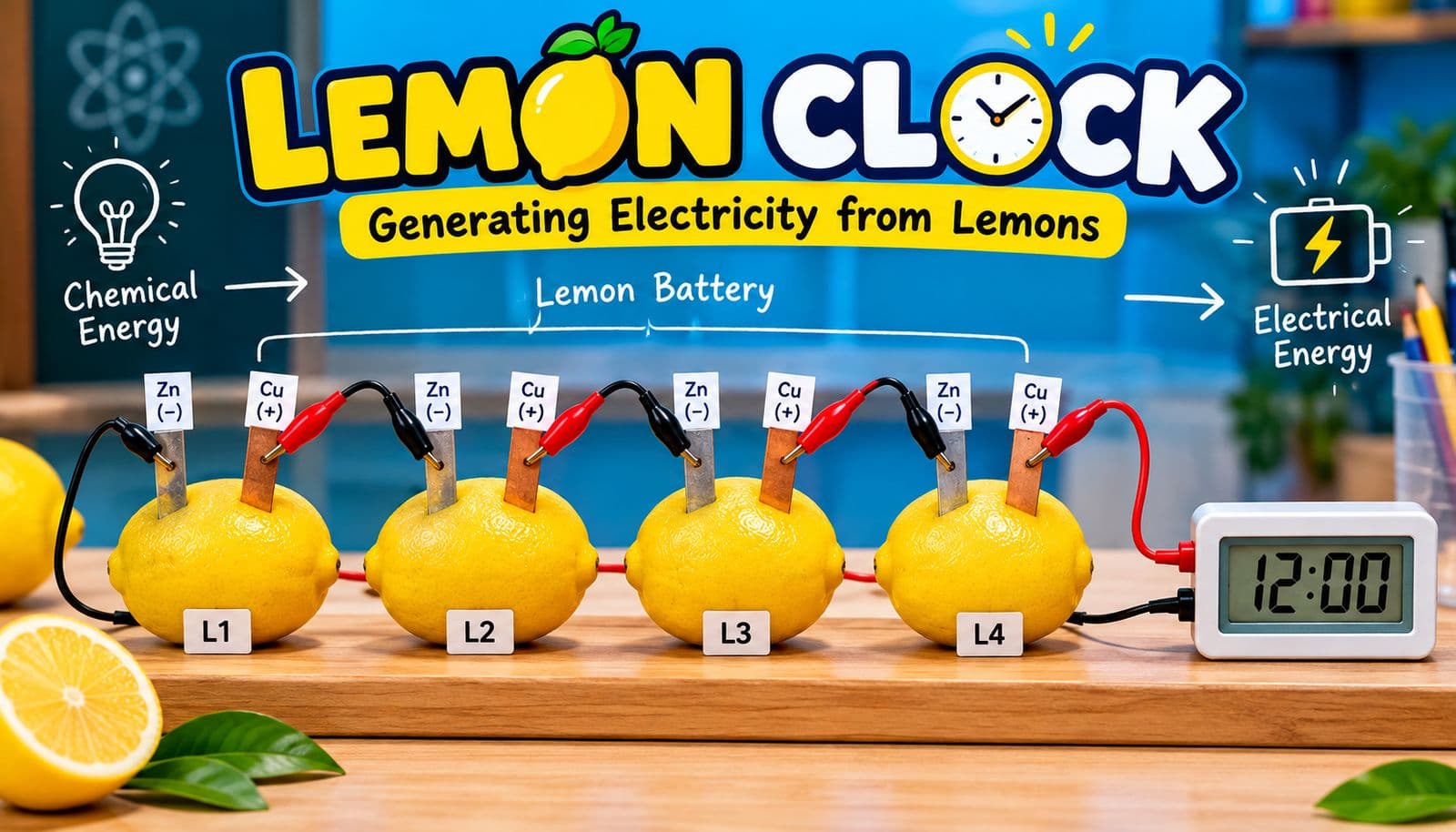
Lemon Clock – Generating Electricity from Lemons
Build a lemon-powered digital clock using zinc, copper and fresh lemons. Discover how electrochemical cells generate electricity and investigate voltage and current.
- Medium
- 1 h
Your Mission
Can four ordinary lemons power a digital clock without a conventional battery?
🍋 Welcome to the Lemon Clock Challenge!
Imagine checking the time on a clock powered by fruit! In this project, you will transform fresh lemons, copper and zinc into a miniature electrical power source.
You will build individual lemon cells, connect them together, measure their voltage and discover whether they can power a specially designed low-energy digital clock.
🔬 Your scientific challenge: Find out how many lemon cells are needed to operate your clock and explain why voltage alone does not guarantee success.
Every observation counts. Even if your clock does not start, your measurements can reveal something important about electricity!
AimBuild and test a lemon-powered clock, investigate series connections and explain how electrochemical reactions convert chemical energy into electrical energy.
What You Need
- Fresh lemons6Start with four. Keep two extra for testing. Choose juicy lemons with unbroken skins.
- Zinc strips6Approximately 5 cm long. Galvanized steel nails are a possible substitute, although results may vary.
- Copper strips6Approximately 5 cm long. Clean, bare copper wire is an alternative.
- Ultra-low-power digital clock module1Choose a clock specifically designed for lemon or potato batteries. Check its voltage and polarity requirements.
- Insulated connecting wires with crocodile clips7–10Use enough wires for five inter-cell connections, two clock terminals and temporary measurements.
- Digital multimeter1Must support low-voltage DC measurements.
- Cardboard or foam display board1Approximately 45 × 30 cm, or another suitable size.
- Paper labels12Label the lemons L1–L6 and identify positive and negative terminals.
- Colored markers1 setUse red for positive and black for negative connections.
- Paper towelsA fewKeep the workspace clean and dry.
Step by Step
Step 1: Prepare your science workstation
Place four lemons in a straight line on a clean, dry display board. Label them L1, L2, L3 and L4. Keep two additional lemons available for later testing. Arrange the electrodes, connecting wires, multimeter and clock nearby.
Step 2: Gently roll the lemons
Roll each lemon under your palm for approximately 10 seconds. Apply gentle pressure without breaking the skin. This helps distribute the juice inside the fruit, improving contact with the metal electrodes.
Step 3: Insert the zinc electrodes
With adult supervision, insert one zinc strip approximately 2–3 cm into each lemon. Leave enough metal exposed to attach a crocodile clip securely.
Step 4: Insert the copper electrodes
Insert one copper strip into each lemon, approximately 2–3 cm away from its zinc electrode. Both metals should contact the lemon juice, but they must not touch each other inside the fruit.
Step 5: Measure your first lemon cell
Set the multimeter to DC voltage. Connect its red probe to the copper electrode of L1 and its black probe to the zinc electrode. Record the displayed voltage. A single zinc-copper lemon cell often produces a measurable voltage below or around 1 V, but the actual reading depends on the materials and conditions.
Step 6: Connect the first two lemons
Use a crocodile-clip wire to connect the copper electrode of L1 to the zinc electrode of L2. Measure the voltage between the free zinc electrode of L1 and free copper electrode of L2. Compare the reading with your first measurement.
Step 7: Build a four-lemon series circuit
Connect copper L2 to zinc L3, then copper L3 to zinc L4. Your three inter-cell connections are now copper L1 to zinc L2, copper L2 to zinc L3 and copper L3 to zinc L4. Leave zinc L1 and copper L4 unconnected for the clock.
Step 8: Check the total voltage
Touch the multimeter's black probe to free zinc L1 and its red probe to free copper L4. Record the total open-circuit voltage. Confirm that the reading is positive and that it is higher than the voltage of a single cell.
Step 9: Check the clock's electrical requirements
Read the clock module's instructions. Identify its positive (+) and negative (−) terminals and required operating voltage. Do not connect the lemon battery if its measured voltage exceeds the clock's permitted input range. Use a clock intended for fruit-battery experiments.
Step 10: Connect the digital clock
Connect the free copper electrode of L4 to the clock's positive terminal. Connect the free zinc electrode of L1 to the clock's negative terminal. Observe the display. If the clock operates, follow its instructions to set the time.
Step 11: Investigate the effect of extra lemons
If the clock does not operate and additional voltage is appropriate for its rating, disconnect the clock. Insert zinc and copper electrodes into L5. Connect copper L4 to zinc L5 and use copper L5 as the new positive terminal. Measure the voltage before reconnecting the clock. Repeat with L6 only if needed and safe for the module.
Step 12: Test voltage under load
If the clock terminals are accessible, carefully measure voltage across them while the lemon battery is connected. Compare this reading with the open-circuit voltage. A large voltage drop indicates that the cells cannot maintain the same voltage while supplying current.
Step 13: Create your exhibition display
Arrange the lemons neatly and position the clock where visitors can see it. Add the title Lemon Clock – Generating Electricity from Lemons, a labeled circuit diagram, your observation table and a short explanation of chemical-to-electrical energy conversion. Secure loose wires without damaging them.
How Does a Lemon Clock Work?
🔬 The secret is electrochemistry!
Each lemon becomes an electrochemical cell when two different metal electrodes are inserted into its acidic juice.
🍋 Lemon juice — The electrolyte The lemon contains water, citric acid and dissolved ions. These allow electrical charge to move through the liquid by ionic conduction.
🔩 Zinc — The negative electrode Zinc atoms can release electrons through a chemical reaction called oxidation.
🟠 Copper — The positive electrode Copper provides a conductive surface where a reduction reaction can take place. In this experiment, the copper itself is not normally the main source of electrical energy.
⚡ What makes electricity flow? When the electrodes are connected through an external circuit, electrons can move through the wires. Meanwhile, ions move through the electrolyte, helping maintain charge balance.
Connecting several lemon cells in series increases their combined voltage. If the circuit supplies enough voltage and current, a compatible ultra-low-power clock can operate.
💡 Remember: The lemon is not a container of ready-made electricity. Chemical reactions involving the electrodes and electrolyte produce the electrical energy.
Understanding the Circuit
🔌 One lemon, one electrochemical cell
Each lemon contains a zinc electrode (negative) and a copper electrode (positive).
To combine four cells, connect them in series:
Connection 1: Copper L1 → Zinc L2 Connection 2: Copper L2 → Zinc L3 Connection 3: Copper L3 → Zinc L4
The two remaining terminals connect to the clock:
Negative (−): Zinc L1 → Clock negative terminal Positive (+): Copper L4 → Clock positive terminal
⚡ Why connect cells in series?
The voltages of individual cells add together when the cells are connected with matching polarity.
For example, if four cells each measure 0.8 V under the same open-circuit conditions, their combined voltage would ideally be approximately 3.2 V. This is an illustrative calculation, not a measured result.
⚠️ Voltage is not the whole story.
Voltage describes electrical potential difference. Current describes the rate at which electrical charge flows. Electrical power is calculated using:
Power (W) = Voltage (V) × Current (A)
Lemon cells have relatively high internal resistance. Their voltage can drop considerably when a device draws current.
Therefore, four lemons may produce an apparently sufficient voltage on a multimeter but still fail to power an ordinary clock. The clock must be compatible with the cells' available voltage and current.
The Science Behind the Chemical Reaction
🧪 Let's investigate what happens at the electrodes.
At the zinc electrode, oxidation occurs:
Zn → Zn²⁺ + 2e⁻
A zinc atom becomes a positively charged zinc ion and releases two electrons.
These electrons can travel through the external circuit toward the copper electrode when the circuit is complete.
At the copper electrode, reduction occurs. In acidic conditions, one possible reaction is:
2H⁺ + 2e⁻ → H₂
Hydrogen ions gain electrons and form hydrogen gas. Dissolved oxygen may also participate in reduction reactions, so the exact chemistry depends on the experimental conditions.
The electrolyte allows ions to move within the lemon, while electrons travel through the external wires.
The resulting electric current can supply energy to a suitable electronic device.
🔍 Important distinction
The zinc is gradually consumed during the reaction. The lemon juice mainly provides an electrolyte, rather than acting as the principal fuel for the battery.
This is a simplified example of a galvanic cell, a device that converts chemical energy into electrical energy through spontaneous electrochemical reactions.
Experiment: How Many Lemons Are Needed?
🧪 Become a battery scientist!
Research question: How does the number of lemon cells connected in series affect the total voltage and the operation of a digital clock?
Your prediction
Before testing, predict whether two, four or six lemons will produce the highest voltage. Predict the minimum number of lemons that might operate your clock.
What to change
Independent variable: Number of lemon cells connected in series.
What to measure
Dependent variables: Total open-circuit voltage, voltage while connected to the clock and whether the clock operates.
What to keep the same
Use the same type of zinc and copper electrodes, similar lemons, approximately equal electrode spacing and the same clock module throughout the experiment.
Create an observation table with these columns:
• Number of lemon cells • Open-circuit voltage (V) • Voltage with clock connected (V) • Clock working? (Yes/No) • Additional observations
Test one, two, three, four, five and six lemon cells, where permitted by the clock's voltage rating.
Record your actual measurements. If you cannot measure voltage under load safely, mark that entry as not measured.
🔎 Questions to investigate
Does voltage increase approximately as more cells are connected?
Does the clock start at a particular number of cells?
Why might the voltage fall when the clock is connected?
Does a higher open-circuit voltage always mean that the clock will operate?
Draw a graph with the number of lemon cells on the horizontal axis and measured open-circuit voltage on the vertical axis.
Use your observations to explain your results instead of assuming the experiment must produce a particular outcome.
What Happened?
Each lemon cell should produce a small measurable DC voltage. Connecting cells in series should generally increase the total open-circuit voltage. A compatible ultra-low-power digital clock may operate if the circuit supplies sufficient voltage and current. Voltage can fall when the clock is connected because lemon cells have internal resistance. Record your actual measurements and whether the clock starts. A clock that does not operate is still a useful experimental observation.
What we learned
Electrochemical reactions convert chemical energy into electrical energy. Series connections increase voltage, but operating a device requires sufficient voltage and current. The properties of electrodes, electrolyte and electrical load all influence battery performance.
Troubleshooting: Why Isn't the Clock Working?
🔧 Scientists solve problems by testing one possibility at a time.
Problem: The multimeter shows zero voltage.
Check that the probes touch clean metal, the electrodes are properly inserted and the multimeter is set to DC voltage. Make sure the two electrodes inside each lemon are not touching.
Problem: The voltage reading is negative.
The measurement polarity is reversed. Connect the red probe to the positive copper terminal and the black probe to the negative zinc terminal.
Problem: The voltage is lower than expected.
Inspect the series connections. Clean oxidized or dirty electrode surfaces. Check whether a loose crocodile clip is causing poor electrical contact.
Problem: The clock display remains blank.
Verify that the clock is intended for fruit-battery operation and that its voltage rating matches the circuit. Check the clock's positive and negative terminals.
Problem: Voltage is sufficient without the clock but falls sharply when connected.
The lemon cells may have too much internal resistance to supply the required current. A high open-circuit voltage does not guarantee enough usable power.
Problem: The clock starts and then stops.
Connections may be unstable, the available current may be insufficient or the cells may be changing as the reactions proceed.
💡 Improvement challenge
Compare fresh electrodes with dirty electrodes, or test larger electrode contact areas. Change only one factor at a time and record what happens.
Never increase the number of cells beyond the clock module's permitted voltage range.
Science Exhibition Questions and Answers
🎤 Prepare to explain your project like a scientist!
Q1. Can lemons really produce electricity?
Yes, when suitable electrodes are inserted into lemon juice, electrochemical reactions can generate a measurable voltage.
Q2. Why do we use zinc and copper?
These materials support different electrochemical reactions, creating a potential difference between the electrodes.
Q3. What is an electrolyte?
An electrolyte is a substance containing mobile ions that allow electrical charge to move through a liquid or other conducting medium.
Q4. Why do we connect lemons in series?
To increase the combined voltage of the electrochemical cells.
Q5. What is the difference between voltage and current?
Voltage is electrical potential difference. Current is the rate of flow of electrical charge.
Q6. Why might an ordinary clock not work?
An ordinary clock may require more current than lemon cells can supply, even when their measured voltage seems adequate.
Q7. What happens if the electrodes touch?
They can create an internal short circuit, reducing useful electrical output.
Q8. Is the lemon itself the source of electrical energy?
Not primarily. The electrical energy comes from electrochemical reactions involving the electrodes and electrolyte.
Q9. Can we use potatoes instead of lemons?
Yes. Potatoes and other moist materials can provide an electrolyte for suitable metal electrodes.
Q10. What is the most important lesson from this project?
A battery converts chemical energy into electrical energy, and successful operation of an electronic device requires both adequate voltage and adequate current.
Real-World Applications
🌍 From lemons to modern technology
The lemon clock demonstrates principles used in many commercial batteries.
⌚ Watches and clocks
Small batteries supply electrical energy to timing circuits and digital displays.
🔦 Portable electronics
Flashlights, remote controls and other devices use batteries to operate without a permanent electrical connection.
🚗 Electric vehicles
Rechargeable battery packs store chemical energy and convert it into electrical energy to power motors and electronic systems.
🛰️ Scientific instruments
Batteries supply energy to portable measuring equipment, remote sensors and certain space instruments.
🔬 Battery research
Scientists investigate electrode materials, electrolytes and battery designs to improve energy capacity, power output, safety and lifespan.
💡 Think bigger
A lemon battery is not a practical replacement for a commercial battery. However, it provides a simple way to understand the scientific principles behind powerful technologies used every day.
Conclusion: Small Fruits, Big Science!
🏆 Congratulations, young scientist!
You have built a series of electrochemical cells using lemons, zinc and copper, measured their electrical output and investigated whether they can power a digital clock.
Your experiment demonstrates three important scientific ideas:
1. Chemical reactions can produce electrical energy.
2. Connecting electrochemical cells in series increases their combined voltage.
3. An electrical device needs enough current as well as the correct voltage to operate.
Whether your clock started successfully or not, your observations help explain how batteries work and why electrical circuits must be designed carefully.
🍋 Your next challenge
Try comparing lemon cells with potato cells or investigate how electrode spacing affects measured voltage. Make a prediction, change one variable and record your findings.
Keep experimenting, keep questioning and keep discovering!